

Population Persistence: Repeat Surveys of Loggerhead Shrikes in a Section of the North Carolina Sandhills
Douglas B. McNair*
*35 Rowell Road, Wellfleet, MA 02667.
Southeastern Naturalist, Volume 25, Issue 1 (2026): 109–130
First published early online: 19 February 2026
Abstract
Lanius ludovicianus (Loggerhead Shrike) has sharply declined over the past 50 years in the Atlantic Coastal Plain of southeastern North America as documented by national coarse-scale surveys (breeding bird surveys, Christmas bird counts) and eBird data. However, Loggerhead Shrike numbers may have stabilized over the last 10 years in some portions of North Carolina. I conducted repeat roadside surveys supplemented by area searches of Loggerhead Shrikes during the non-breeding and breeding seasons in 2024–2025 at 87 previously documented historical breeding sites (1979–1994, 2012–2013) to compare occupancy between time periods and examine land-cover use between historical sites that were still occupied and sites that were now unoccupied. I also recorded 9 newly discovered sites in either season. The study area was predominantly located in the agricultural landscapes of the Sandhills, a subregion of the Coastal Plain, in Richmond County, NC, and smaller areas of 4 adjacent counties. I documented 52 occupied historical sites during each of the non-breeding and breeding seasons; 46 constituted resident territories (occupied during both seasons), whereas 6 sites were each occupied only in the non-breeding or breeding seasons. Including newly discovered sites in 2025, most breeding-season territories were in the Sandhills (n = 49), where I estimate the current breeding density to be 4.1 pairs/100 km2, similar to their population density in 2012–2013. Their less dense population in the adjacent Piedmont and along the Fall Line (contact zone of the Piedmont with the Sandhills and Coastal Plain) of 1.1 pairs/100 km2 is also similar to their estimated population density in 2012–2013. More than half of the oldest breeding sites in 1979–1994 (15 of 28; 54%) were occupied by Loggerhead Shrikes in 2025. Population persistence was high at historical sites with larger areas of pastureland and smaller areas of developed habitat. This study reaffirms the importance of conducting fine-scale surveys to produce a precise estimate of a persistent population and key land-cover class features for Loggerhead Shrikes near the edge of their current range in this section of the North Carolina Sandhills. This approach can also be used to estimate population sizes and key land-cover class features for range-edge or isolated Loggerhead Shrike populations outside of North CarolinaA.
 Download Full-text pdf (Accessible only to subscribers. To subscribe click here.)
Access Journal Content
Open access browsing of table of contents and abstract pages. Full text pdfs available for download for subscribers.
Issue-in-Progress: Vol. 25( 3) ... early view
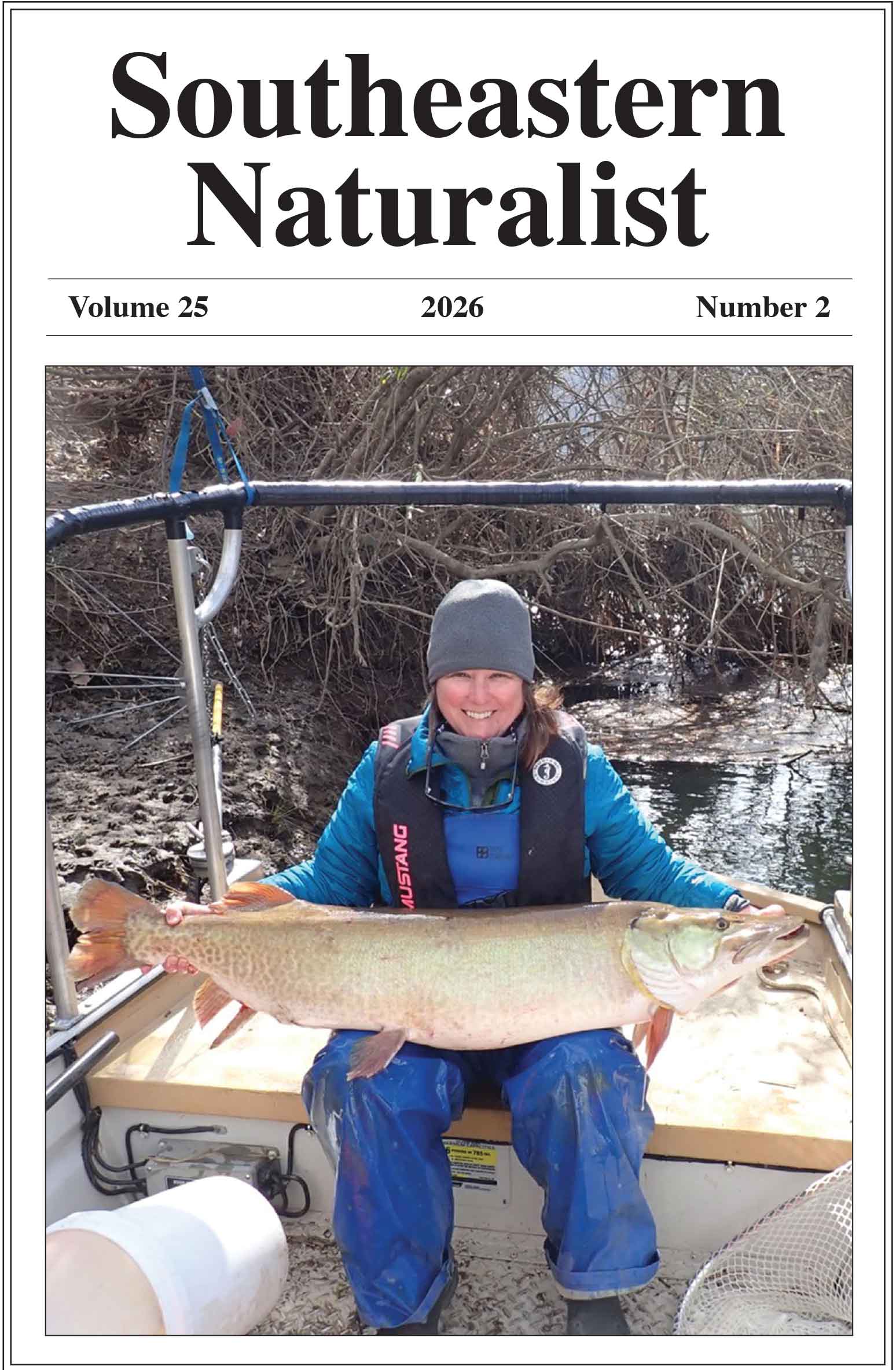
Check out SENA's latest Monograph and current Special Issue in progress:









 The Southeastern Naturalist is a peer-reviewed journal that covers all aspects of natural history within the southeastern United States. We welcome research articles, summary review papers, and observational notes.