

Not So Fatal Attraction: Captive Female Burmese Python Lures Do Not Improve Wild Python Detection
Alex D. Potash1, Maggie Jones1,*, Michael Kirkland2, Jenna Cole2, Kristen Hart3, and Robert McCleery1
1Department of Wildlife Ecology and Conservation, University of Florida, Gainesville, FL 32601.2Land Resources Bureau, South Florida Water Management District, West Palm Beach, FL 33406.3US Geological Survey, Wetland and Aquatic Research Center, Davie, FL 33314. *Corresponding author.
Southeastern Naturalist, Volume 25, Issue 2 (2026): 191–200
First published early online: 4 May 2026
Abstract
The ongoing invasion of Python bivittatus (Burmese Python; henceforth, Python) across the Greater Everglades Ecosystem (GEE) has led to near total collapse of the affected mammal community over the past few decades. Management efforts to eliminate Pythons and control their spread have been hampered by the Python’s low detectability, which may be improved by using a lure. In controlled settings, male Pythons show an attraction to the scent from reproductively active females. To test the effectiveness of using reproductively active female Pythons as a lure for attracting wild male Pythons in the field, we conducted a paired experiment with wild-caught female Pythons in pens and empty control pens. We monitored Python visitation at all sites using camera traps, which resulted in >3,000,000 photographs that we filtered to 4 independent detections of Pythons using AI software. Python detection was low at sites with female Pythons (3 observations) and control sites (1 observation) over 90 days at 12 sites. Stress associated with captivity may have halted reproductive females from producing pheromones, eliminating the chemosensory cue that lures males. Identifying and implementing husbandry techniques to reduce stress in wild-caught female Pythons could improve the effectiveness of this technique. Little is currently known about the chemical ecology of Pythons, and pheromonal communication in particular, and further research in this area could aid in the identification and production of effective, low-cost lures to increase detection and removal of this invasive species.
 Download Full-text pdf (Accessible only to subscribers. To subscribe click here.)
Access Journal Content
Open access browsing of table of contents and abstract pages. Full text pdfs available for download for subscribers.
Issue-in-Progress: Vol. 25( 3) ... early view
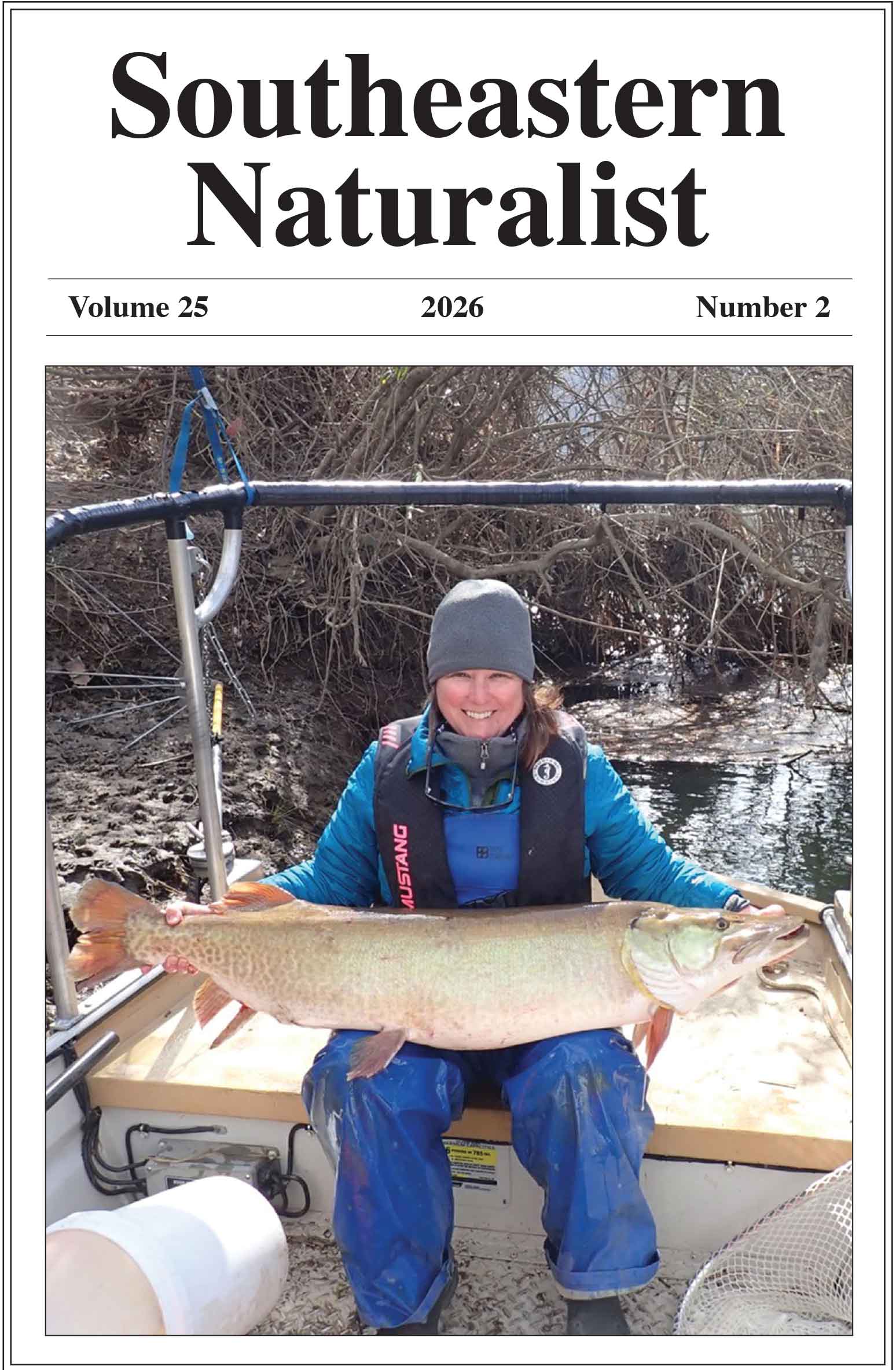
Check out SENA's latest Monograph and current Special Issue in progress:









 The Southeastern Naturalist is a peer-reviewed journal that covers all aspects of natural history within the southeastern United States. We welcome research articles, summary review papers, and observational notes.