

Environmental Factors and Individual Characteristics Influencing Mussel Survival During a Dewatering Event
Jonathan M. Miller1,*, Nguyen Tien Anh Quach1,2,3, Meet Patel1,4, and Alban Guillaumet1
1Department of Biological and Environmental Sciences, Troy University, Troy, AL 36082.2Department of Biological Sciences, Towson University, Towson, MD 21252.3Current address - Department of Geography, University of North Carolina at Chapel Hill, Chapel Hill, NC 27599. 4Current address - Department of Biology, University of Kentucky, Lexington, KY 40506. *Corresponding author.
Southeastern Naturalist, Volume 25, Issue 2 (2026): 201–221
First published early online: 31 May 2026
Abstract
We used a 13-week drawdown at Alabama’s Gantt Reservoir to study the consequences of severe drought and dewatering on the survival of a freshwater mussel, Elliptio pullata (Gulf Spike). Once a week, we selected 50 cm × 50 cm soil quadrats at random from 3 different depth zones and excavated and searched for mussels. We collected a total of 875 live or fresh-dead Gulf Spike mussels in 228 unique quadrats. Generalized linear mixed models revealed that survival declined sharply over time, with ~82% live mussels on week 1 and only ~12% on week 13. Survival probability was greater for intermediate-sized mussels, when mussels were buried in sediment, cover or shading was present nearby, and/or quadrat moisture was higher. Thus, it may be that timing controlled drawdowns to coincide with periods of high soil moisture could improve mussel survival, especially in areas that provide cover or refuge.
 Download Full-text pdf (Accessible only to subscribers. To subscribe click here.)
Access Journal Content
Open access browsing of table of contents and abstract pages. Full text pdfs available for download for subscribers.
Issue-in-Progress: Vol. 25( 3) ... early view
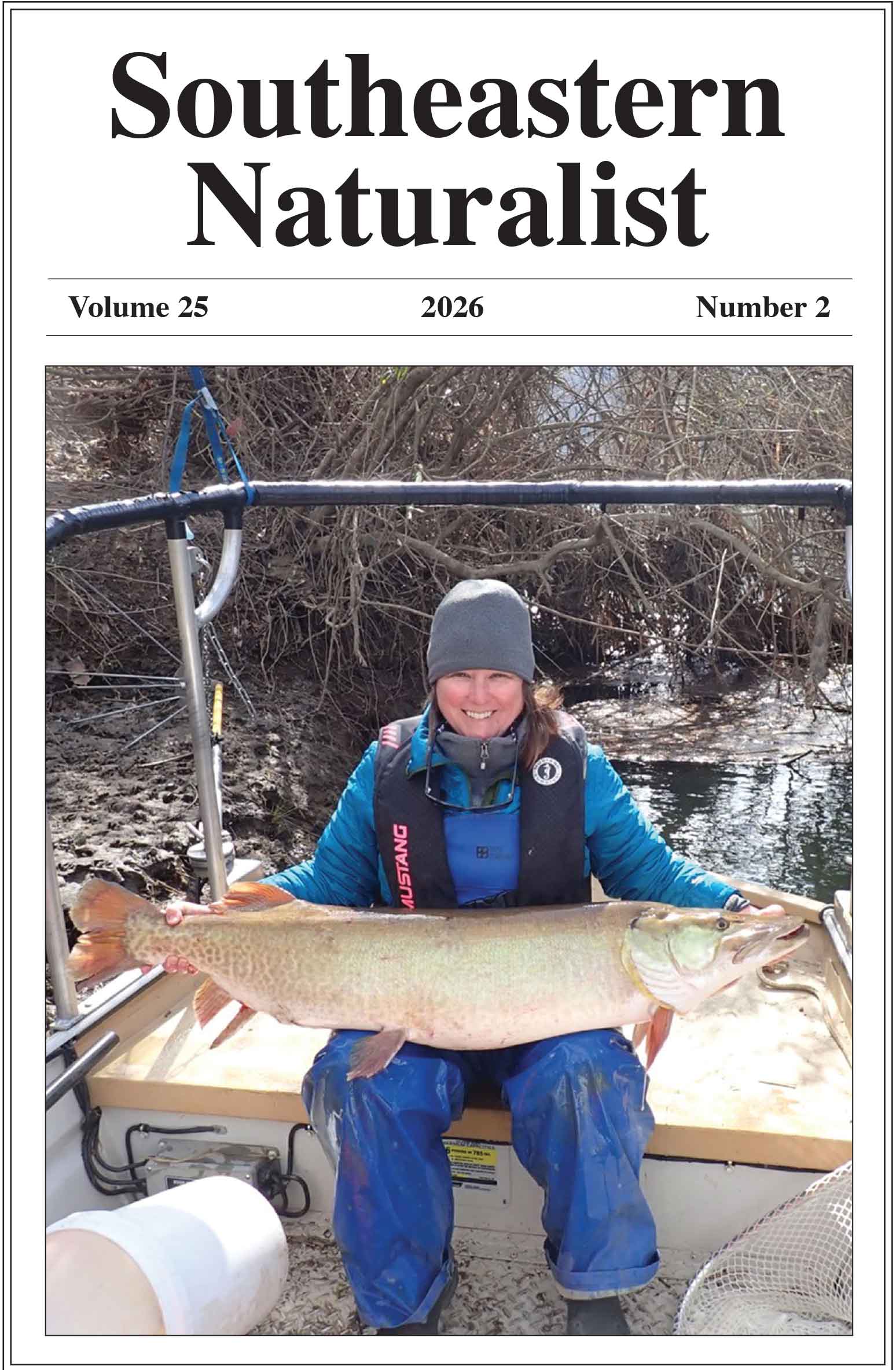
Check out SENA's latest Monograph and current Special Issue in progress:









 The Southeastern Naturalist is a peer-reviewed journal that covers all aspects of natural history within the southeastern United States. We welcome research articles, summary review papers, and observational notes.