

White-nose Syndrome-induced Changes in Bat Populations on Ozark Plateau National Wildlife Refuge, Oklahoma
Lynn W. Robbins1,*, Richard Stark2, Patrick R. Moore1, and Virgil Brack Jr.1
1Environmental Solutions & Innovations, Inc., Cincinnati, OH 45232.2North Carolina Wildlife Resources Commission, Waynesville, NC 28786. *Corresponding author.
Southeastern Naturalist, Volume 25, Issue 2 (2026): 297–316
First published early online: 26 June 2026
Abstract
We conducted field studies at Duncan Field Cave on Ozark Plateau National Wildlife Refuge in eastern Oklahoma over 7 autumn and 5 spring periods (2013–2022) and documented population changes and demographic differences in bat species including 3 listed as endangered and 1 proposed for listing by the US Fish and Wildlife Service under the Endangered Species Act. We used harp traps and mist nets placed near entrances to capture and process 3177 bats of 9 species. Autumn 2015 captures and estimates of bats released unprocessed indicated >1000 each of Myotis septentrionalis (Northern Long-eared Bat) and Perimyotis subflavus (Tricolored Bat) present at the cave in autumn 2015. During winter intracave surveys 2012–2022, we identified 5 species with a maximum of 583 bats in 2017 and a minimum of 17 individuals in 2022. We documented significant declines in Northern Long-eared (100%) and Tricolored (90%) bats after the arrival of the fungal pathogen Pseudogymnoascus destructans (Pd) that causes white-nose syndrome. By the end of these studies, the Northern-Long-eared Bat was no longer encountered and possibly absent, whereas a few Tricolored Bats persisted. Endangered Myotis grisescens (Gray Bat) and Corynorhinus townsendii ingens (Ozark Big-eared Bat) at Duncan Field Cave did not show population changes after the arrival of Pd.
 Download Full-text pdf (Accessible only to subscribers. To subscribe click here.)
Access Journal Content
Open access browsing of table of contents and abstract pages. Full text pdfs available for download for subscribers.
Issue-in-Progress: Vol. 25( 3) ... early view
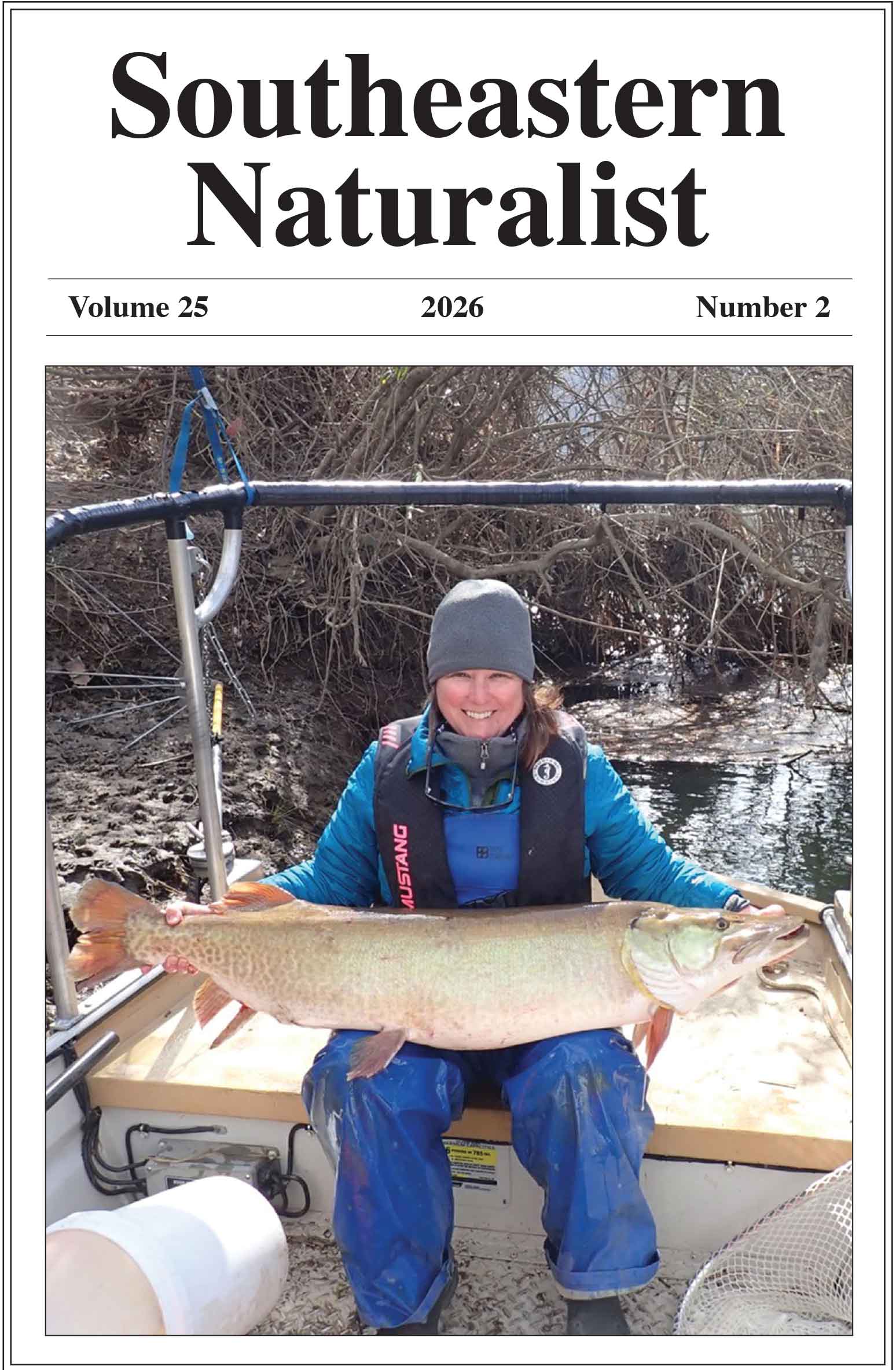
Check out SENA's latest Monograph and current Special Issue in progress:









 The Southeastern Naturalist is a peer-reviewed journal that covers all aspects of natural history within the southeastern United States. We welcome research articles, summary review papers, and observational notes.