

A Disjunct Population of the Three-lined Salamander (Eurycea guttolineata) in Alachua County, Florida
Kevin M. Enge1,*, Laura Suthar2, Matthew T. Fedler3, Benjamin W. Genter3, Richard D. Owen4, Jonathan D. Mays1, and David A. Beamer5
1Fish and Wildlife Research Institute, Florida Fish and Wildlife Conservation Commission, 1105 SW Williston Road, Gainesville, FL 32601. 2Florida Department of Environmental Protection, San Felasco Hammock Preserve State Park, Gainesville, FL 32653. 3Division of Herpetology, Florida Museum of Natural History, University of Florida, Gainesville, FL 32611. 4Florida Department of Environmental Protection, Division of Recreation and Parks District Two, 4801 Camp Ranch Road, Gainesville, FL 32641. 5Graduate School of Human and Environmental Studies, Kyoto University, Yoshida Nihonmatsu-cho, Sakyo, Kyoto, Japan. *Corresponding author.
Southeastern Naturalist, Volume 25, Issue 3 (2026): 317–325
First published early online: 12 August 2026
Abstract
In 2024, a population of Eurycea guttolineata (Three-lined Salamander) was discovered in the Millhopper Sink, a large sinkhole in Alachua County, FL, that is ~200 km from the nearest known populations. Given the extensive history of salamander research at the Millhopper site, this observation was unexpected. We believe the population is introduced but were unable to identify its geographic origin because individuals shared a haplotype with 3 populations in Georgia and Alabama. This breeding population is apparently confined to the sinkhole and a seepage stream that enters it, but the population will be monitored to see if it expands its distribution.
 Download Full-text pdf (Accessible only to subscribers. To subscribe click here.)
Access Journal Content
Open access browsing of table of contents and abstract pages. Full text pdfs available for download for subscribers.
Issue-in-Progress: Vol. 25( 3) ... early view
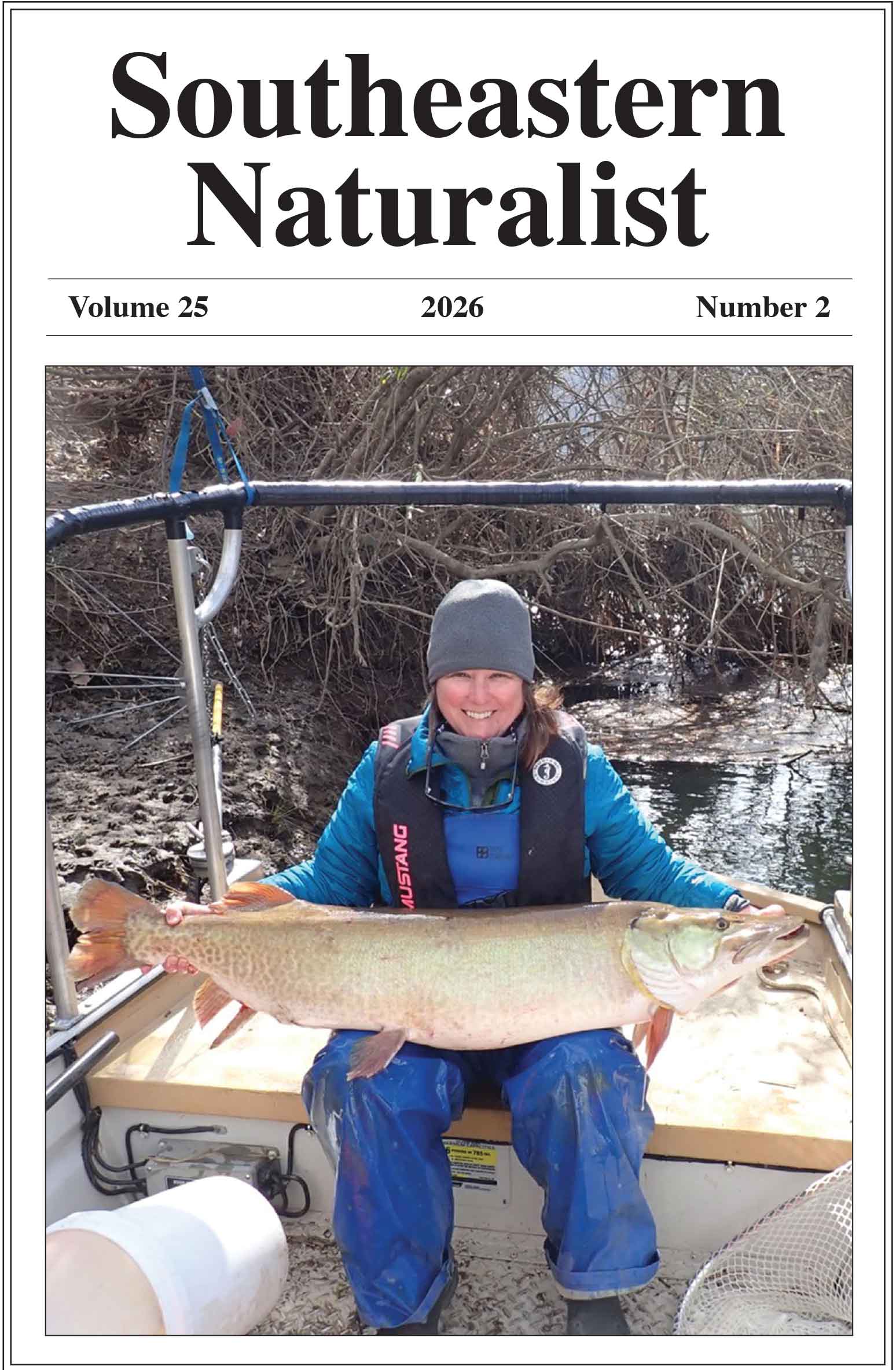
Check out SENA's latest Monograph and current Special Issue in progress:









 The Southeastern Naturalist is a peer-reviewed journal that covers all aspects of natural history within the southeastern United States. We welcome research articles, summary review papers, and observational notes.